Drywall Installation in Toronto & the GTA
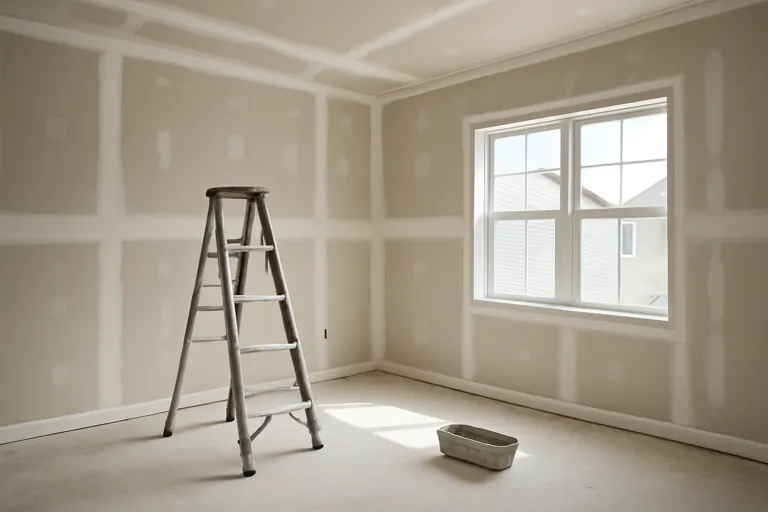
There's a gap in the market between a patch and a renovation: the laundry room that was never boarded, the basement wall opened up for a plumbing fix, a bulkhead to hide new ductwork, or a closet that needs one fresh wall. Drywall companies want whole basements; this is exactly the size of job we take on. We hang drywall, tape it and finish it ready for paint — small drywall jobs done to the same standard as big ones.
Good board and tape work is mostly about sequence and patience. Board gets hung with staggered joints, screws set just below the surface without breaking the paper, and gaps kept tight so the tape has something to grab. Then tape is embedded in compound — paper or mesh depending on the joint — followed by two more coats, each wider than the last, with real drying time in between. The classic shortcuts are rushing coats before they're dry and skipping the priming step; both show up as ridges and flashing the first time light rakes across the wall. A proper finish (level 4 for painted walls) means you see a wall, not a map of the joints.
For a quote, tell us roughly how many square metres or which surfaces need boarding, the framing situation (bare studs, strapping, or existing wall), ceiling height, and whether you want us to prime and paint as well. Photos of the space help us spot things like insulation, vapour barrier or wiring that should be handled before the wall closes up.
What our drywall installation service includes
- Hanging drywall on walls and ceilings in single rooms and small spaces
- Board and tape for bulkheads, ductwork boxes and beam enclosures
- Closing up walls and ceilings after plumbing or electrical work
- Drywall finishing — taping, bedding and three-coat feathering
- Moisture-resistant board in laundry areas, bathrooms and basements
- Corner bead installation on outside corners and openings
- Sanding to a paint-ready level 4 finish with dust control
- Priming new board so the paint coat covers evenly
- Vapour barrier checks and small insulation top-ups before closing walls
- Disposal of offcuts and site cleanup
Drywall Installation cost in Toronto: what affects the price
- Surface area and layout — one flat wall is quick; a room with corners, windows and a bulkhead has far more taping per square metre
- Ceilings versus walls — overhead hanging is slower, needs two sets of hands or a lift, and finishing has to be flatter because light rakes across ceilings
- Framing condition — bowed or unevenly spaced studs need shimming or strapping first, or the finished wall will wave
- What goes behind the board — insulation, vapour barrier and blocking for future shelves or TVs are cheap to add now and disruptive to add later
- Finish level — a garage can take a lower finish; a living room wall under pot lights needs careful feathering and sometimes a skim coat
- Drying time between coats — taping is a three-visit rhythm in most homes, and humidity in basements stretches it; we schedule around it rather than rush it
Every home is different, so we don’t publish flat prices — the quote is free and based on your actual job. See how handyman pricing works in the GTA.
How a drywall installation job works with us
Describe the job
Tell us about the drywall installation in your own words and add a few photos from your phone — sizes and wall or surface type help.
Get a free quote
We review the details, ask a question if something is unclear, and come back with a quote. No obligation.
Book a visit
If you go ahead, the visit is scheduled at a time that suits you — with licensed trades where Ontario law requires them.
Drywall Installation questions from Toronto homeowners
Do you take on small drywall jobs? Most companies won't call back.
How many visits does drywall finishing actually take?
Can you match my new wall to the existing walls around it?
Should anything be done inside the wall before you board it up?
Do you build bulkheads to hide pipes and ducts?
Ready to sort out your drywall installation?
Tell us what your home needs — a small fix or a full project — and get a free quote.